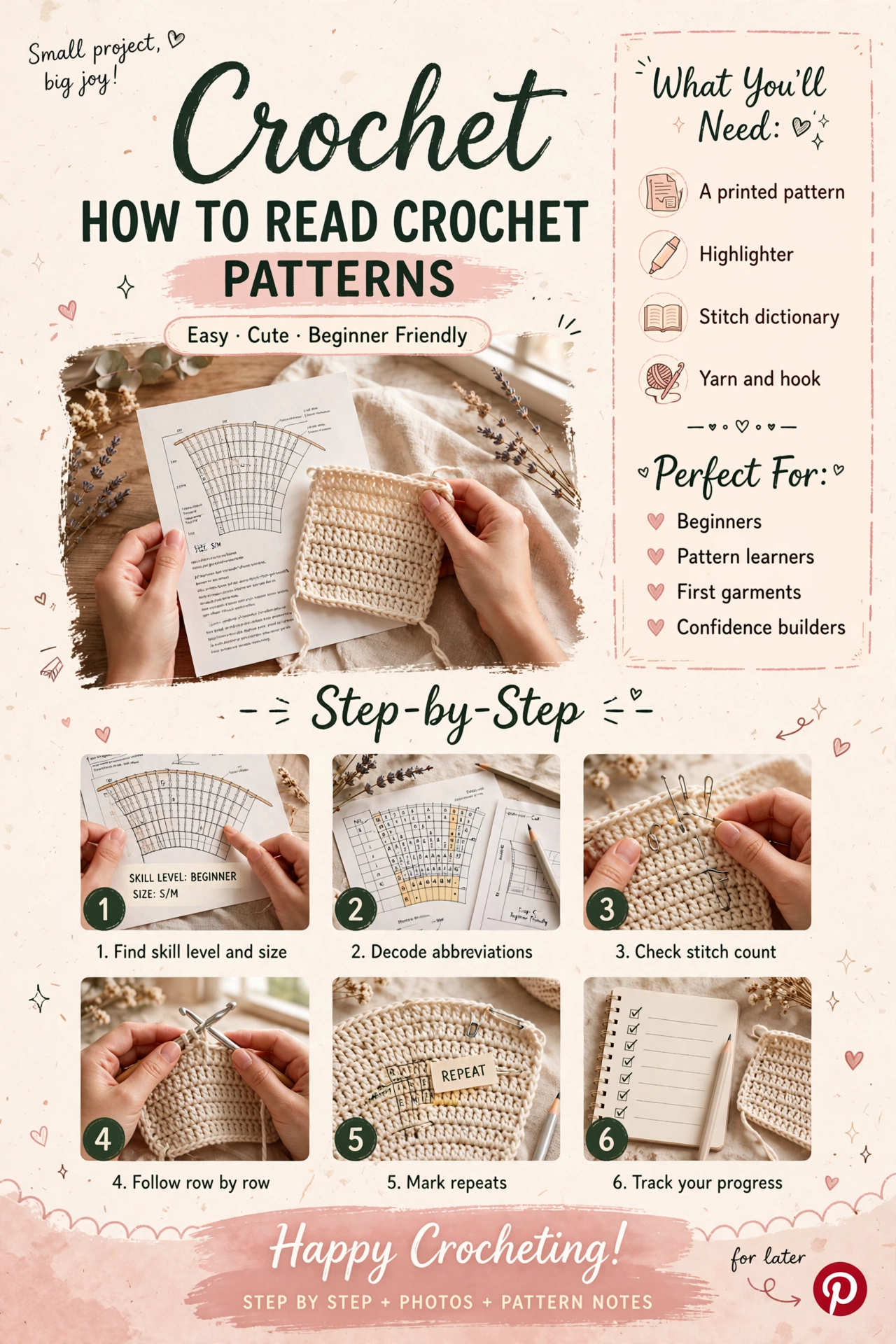
Hey, it’s Sara — patterns stop feeling like riddles when you know the anatomy, symbols, and checkpoints.
Hey, it’s Sara
Reading a pattern is a skill of its own — separate from making the stitches. I’m Sara, and the day patterns stopped feeling like riddles was the day I started reading them like cooking recipes: ingredients first, then method, one line at a time.
Anatomy of a pattern
- Title & level — beginner / easy / intermediate.
- Materials — yarn weight, approximate yardage, hook, notions.
- Gauge — stitches and rows over 4 in / 10 cm. Matters for clothes; less critical for scarves and toys if you’re flexible on size.
- Abbreviations — always check; designers vary.
- Notes — turned rows vs rounds, special stitches, construction order.
- Instructions — the actual rows/rounds.
Repeats, brackets, asterisks
- *…* repeat — do the bit between asterisks as many times as written.
- ( … ) in next st / space — all stitches inside the parentheses go into the same place.
- [ … ] 3 times — do the whole bracketed sequence three times.
A tiny pattern to decode
Row 1: Sc in 2nd ch from hook and in each ch across. Turn. (10)
Row 2: Ch 1, sc in each st across. Turn. (10)
Repeat Row 2 until piece measures 4 in (10 cm). Fasten off.
Translation: make a small rectangle 10 stitches wide and 4 inches tall in single crochet. The number in parentheses is your checkpoint count at the end of the row.
Habits that save frogging
- Read the entire pattern once before you start — especially the finishing section.
- Highlight the row you’re on.
- Count stitches at the end of every row for the first ten rows until the rhythm settles.
- When something feels wrong, stop at the end of the row. Don’t “hope it blocks out” for ten more rows.
Use the stitch count as your built-in error detector
When a pattern gives a number in parentheses at the end of a row or round, I treat it as a checkpoint rather than decoration. Count before starting the next instruction. One missing stitch can become two missing stitches after an increase round, and fixing it immediately is much easier than finding it six rows later.
Also check whether the pattern uses US or UK terminology. A US single crochet is called a double crochet in UK terminology, so that one detail can change the entire fabric. Sara Rain Crochet tutorials use US terms unless the page says otherwise.
If abbreviations are slowing you down, keep my crochet abbreviation guide open beside the pattern.
A complete mini-pattern, line by line
Here is a tiny practice circle that lets you use the language instead of only reading definitions. It uses US terms: ch = chain, sc = single crochet, inc = two single crochets in one stitch.
R2: Inc in each st around. (12)
R3: *Sc in next st, inc in next st; rep from * around. (18)
R4: *Sc in next 2 sts, inc in next st; rep from * around. (24)
Round 1: the six stitches all go into the adjustable ring. The (6) confirms the round has six stitches.
Round 2: work two single crochets into every one of those six stitches. Six increases create twelve stitches.
Round 3: the repeat uses two stitches from the previous round: one normal single crochet in the first, then two single crochets in the second. Repeat that sequence six times. You finish with 18 stitches.
Round 4: the repeat gets one stitch longer: two ordinary single crochets followed by one increase. Six repeats add six stitches again, taking the count from 18 to 24.
That progression also shows why counts matter. If Round 3 ends with 17 stitches, Round 4's repeat will not divide cleanly. Fixing the missing stitch before continuing is easier than trying to repair the circle later.
How to decode a complicated line on paper
I break this into chunks before touching the yarn. First: two single crochets in two separate stitches. Second: half double crochet, double crochet, half double crochet all share the next stitch because they are grouped in parentheses. Third: one single crochet in each of the next two stitches. Then the instruction says to repeat the whole sequence three more times, for four copies total.
If I am interrupted, I mark which repeat I just completed. That is much safer than trying to remember whether I was on repeat two or three after coming back.
Before you start: five details I check
- US or UK terms? Never assume from the word “double crochet.”
- Rows or continuous rounds? Continuous rounds need a marker because there is no obvious join.
- Does the turning chain count as a stitch? The pattern notes should tell you.
- Where is gauge important? A fitted hat needs more precision than a dishcloth.
- What does “repeat” include? Find the asterisk, brackets, or explicit start and end before working the first repeat.
If the shorthand itself is unfamiliar, my stitch abbreviation guide has several translated examples. If the practice circle is new to you, the magic ring tutorial covers the starting loop separately.
Final note from Sara
Patterns are maps, not tests. Go slow, count often, and ask for help when a line doesn’t make sense — including from future-you after a cup of tea.
Pattern-reading practice exercise
Sample yarn: worsted #4 · Hook: 5 mm · Gauge target: about 15 sc × 16 rows per 10 cm (4 in).
Abbreviations
ch = chain · sc = single crochet · dc = double crochet · rep = repeat · st = stitch.
Numbered exercise
- Chain 17.
- Sc in the second chain from the hook and across: 16 sc.
- Ch 1, turn. Sc across: 16 sc.
- Repeat the previous row four more times.
- At the end of the sixth row, count 16 stitches before continuing.
How to decode the instruction
Numbers in parentheses usually report a stitch count, while brackets or asterisks commonly mark a repeat. The pattern's own abbreviation key always wins if it defines a term differently.
Troubleshooting
If your count is wrong, compare the beginning and end of the row first. If the wording contains a comma or semicolon, separate each action before deciding where the stitches belong.
Finishing
Write the final stitch count beside each row in pencil or a project note. This simple habit prevents small errors from multiplying.