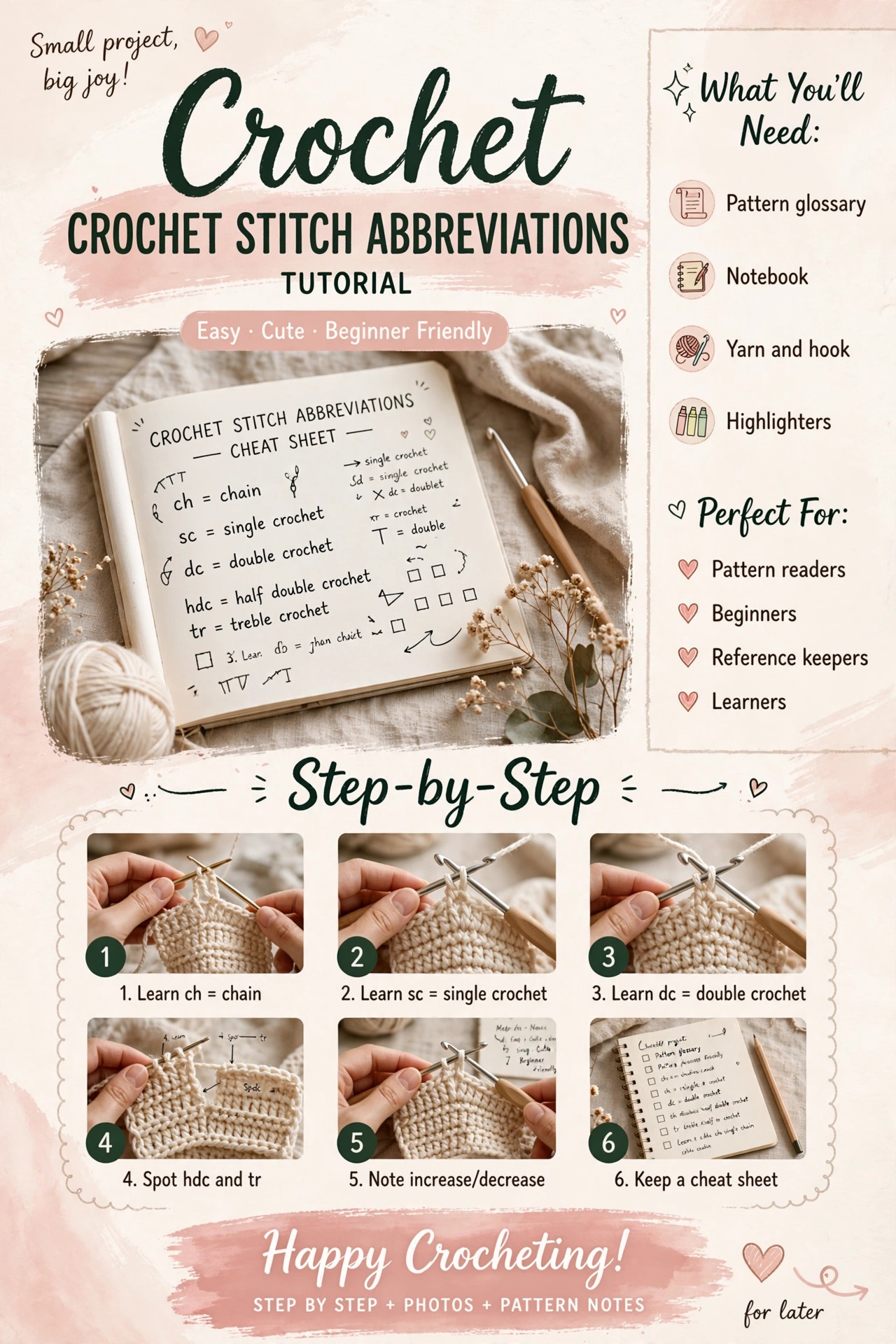
Hey, it’s Sara — the abbreviation cheat sheet I still use, with US terms and common pattern combos.
Hey, it’s Sara
Patterns look like secret code until the abbreviations click. I’m Sara — this is the cheat sheet I still glance at when a designer gets creative.
These are US terms (used on this site). UK terms differ: UK dc = US sc, UK tr = US dc.
Core abbreviations
- ch — chain
- sl st — slip stitch
- sc — single crochet
- hdc — half double crochet
- dc — double crochet
- tr — treble (triple) crochet
- st(s) — stitch(es)
- sp — space
- rep — repeat
- rnd — round
- RS / WS — right side / wrong side
- FLO / BLO — front loop only / back loop only
- inc — increase (usually 2 sts in one st)
- dec / sc2tog — decrease (two stitches together)
Common combinations
- sc2tog — single crochet two together (one decrease)
- (3 dc, ch 2, 3 dc) — classic granny corner in one space
- *sc, 2 sc in next*; rep around — increase round for circles
- ch-sp — the space under a chain (not a stitch top)
How to read them in a pattern
- Skim the whole abbreviation list the designer provides — some use personal shortcuts.
- Parentheses ( ) = work all of that into the same place.
- Asterisks * * = repeat the section between them.
- Brackets often group a sequence that’s done a number of times.
How I read a pattern line without getting lost
I read one instruction at a time and translate punctuation into actions. Parentheses usually group stitches worked together or show the stitch count at the end. An asterisk marks a repeat. “Around” means keep repeating through the round; “across” means work to the end of a row.
For example, *sc, inc; repeat from * around (18) means single crochet once, work an increase in the next stitch, then repeat that two-stitch sequence until the round ends. The final 18 is your check. If you have 17 or 19, fix the count before moving on.
For a complete worked example, use the notation alongside my pattern-reading guide.
Three pattern lines, translated
Abbreviations that change where the hook goes
BLO and FLO change which loop of the stitch you work under. ch-sp sends the hook into the open space made by chains instead of into the V-shaped top of a stitch. sk means skip, so do not accidentally work into the skipped stitch on the same pass.
2 sc in next st and sc2tog sound similar when you are reading quickly, but they do opposite things: the first increases the stitch count by one; the second combines two stitches into one and decreases the count by one.
US vs UK terms: the trap worth checking first
US and UK crochet use some of the same words for different stitches. In particular, US sc = UK dc, US dc = UK tr, and US tr = UK dtr. If a pattern seems dramatically taller or shorter than its photo, check the terminology before changing your tension.
When a designer supplies an abbreviation key, use that key over any generic chart. For practice reading a whole set of instructions, continue with my how to read crochet patterns guide.
Final note from Sara
You don’t need to memorize everything tonight. Learn the five you use most; the rest will follow project by project.
Use abbreviations in a real mini pattern
Sample yarn: worsted #4 · Hook: 5 mm · Gauge target: about 15 sc × 16 rows per 10 cm (4 in).
Core abbreviations
ch = chain · sc = single crochet · hdc = half double crochet · dc = double crochet · sl st = slip stitch · inc = increase · dec = decrease · rep = repeat · rnd = round · st = stitch.
Numbered practice
- Ch 17.
- Sc in the 2nd ch from hook and across. (16 sc)
- Ch 1, turn; sc across. (16 sc)
- Rep Row 3 four times.
- Fasten off and weave the end.
How to verify a pattern
Read the abbreviation key first. Then identify the action, location, repeat and expected stitch count. A stitch count is one of the best checkpoints you have.
Troubleshooting & finishing
If a symbol or abbreviation conflicts with your pattern's own glossary, follow that pattern's definition. Keep a written note of unfamiliar terms and weave the final ends securely.