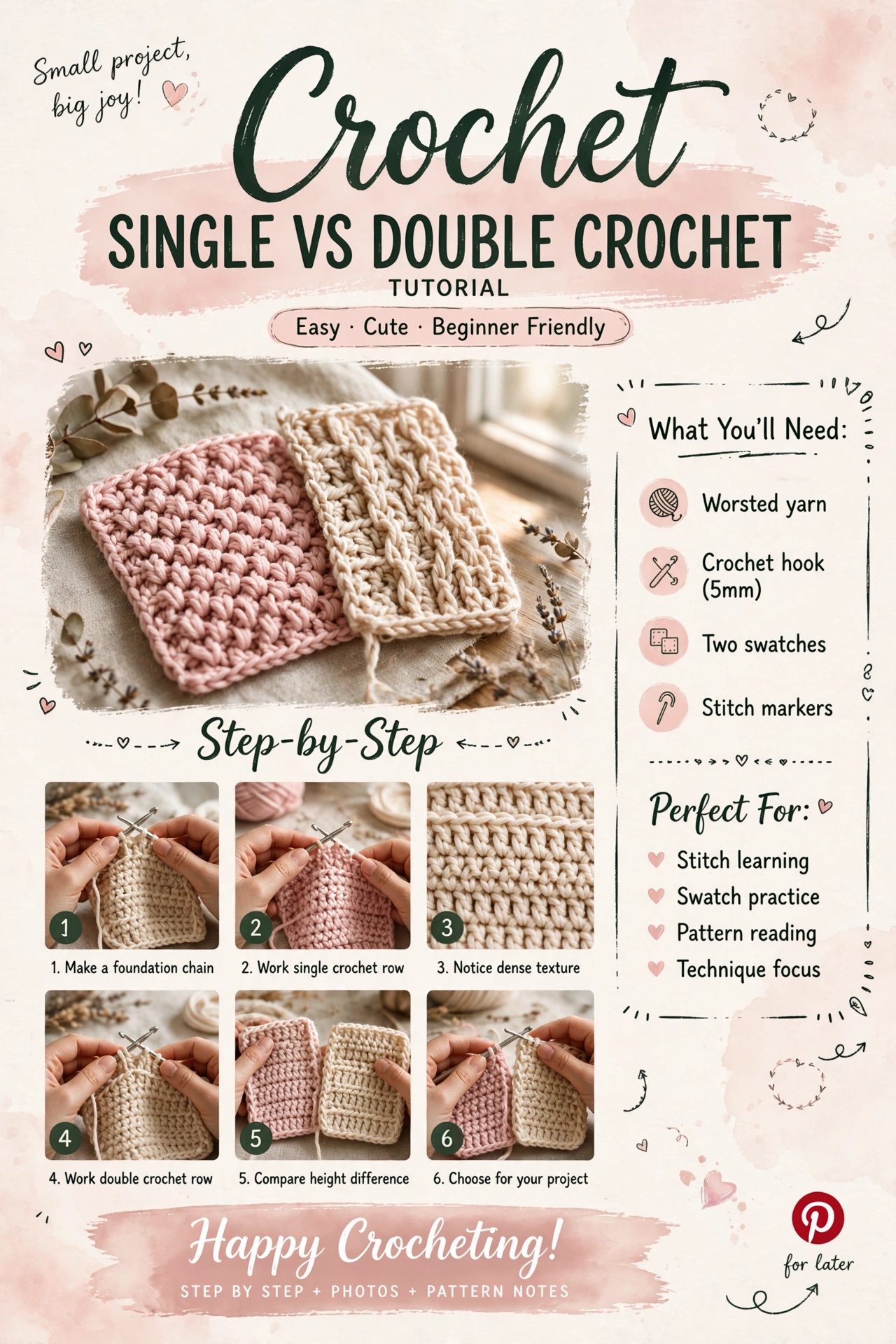
Make both stitches in one swatch so you can see the difference in height, density and drape.
Work through the guide in order and use the checkpoints before moving to the next stage.
Materials & preparation
Before you start
Set out your yarn, hook, scissors and needle. Read the complete instructions once before making the first stitch. Write down any target stitch count or finished measurement so you can check your work as you go.
Gauge & tension
Your yarn, hook and personal tension determine the finished fabric. When size matters, make a small swatch and let it rest flat before measuring. Do not force your hands to match a number by gripping the hook harder.
Core pattern / method
Materials
- Worsted yarn, about 40 yd / 36 m
- 5 mm hook
- Ruler and needle
Pattern
- Foundation: Ch 22.
- Rows 1–4: Ch 1, turn. Sc across. 21 sc each row.
- Rows 5–8: Ch 3, turn. Dc across. 21 dc each row.
- Row 9: Ch 1, turn. Sc across. 21 sc.
- Border: Sc around, working 2 sc in each corner. Fasten off.
What you should notice
Single crochet creates a shorter, denser fabric. Double crochet grows faster and leaves more air between stitches. Use the shorter stitch for firm fabric and the taller stitch when you want speed and drape.
Compare the two fabrics
Lay the single-crochet and double-crochet sections flat without stretching them. Compare height, thickness, visible gaps and flexibility. The stitch count should remain 21 across both sections; the difference in height should come from stitch construction, not accidental increases.
Common sc and dc mistakes
My rows keep getting wider
Check whether you are working into a turning chain as though it were an extra stitch. Follow the pattern's instruction about whether the turning chain counts.
Double crochet is too tight
Do not pull the yarn-over snug before drawing through the loops. Keep the working loop tall enough for the hook to move smoothly through two loops at a time.
I cannot see the difference
Use a smooth, light-colored yarn and make at least four rows of each stitch. A tiny sample or fuzzy yarn can hide the change in stitch anatomy.
Finish the comparison swatch
Work the optional single-crochet border only after confirming the center sections have equal stitch counts. A border can tidy the sample, but it should not be used to disguise missing edge stitches. Weave in the tails and keep the swatch as a reference when choosing stitches for future projects.
When to choose each stitch
Single crochet is useful when you want compact fabric, such as amigurumi, sturdy pouches or dense edging. Double crochet is useful when you want faster height, more drape or a more open fabric, such as many blankets and scarves. Neither stitch is automatically better; choose based on how the finished fabric needs to behave.
Try the same sampler with a larger hook and compare how hook size changes both stitches without changing their basic structure.
Keep the swatch as a stitch reference
Label the swatch with yarn weight and hook size. It becomes a useful physical reference for how dense single crochet and double crochet feel in the same materials, especially when planning a project without a prescribed stitch.
Choose the stitch by the fabric you want
Single crochet makes a shorter, denser fabric, which is why it appears so often in amigurumi and structured pieces. Double crochet grows faster and creates a taller, more open fabric that works well for scarves, blankets, and many granny-style projects.
Neither stitch is “better.” If I want stuffing hidden, I reach for single crochet. If I want drape and faster progress, double crochet often makes more sense. Make ten stitches of each with the same yarn and hook—the difference is much clearer in your hands than in a definition.
Final notes
Use this page as a working reference: practice the technique, check the specific checkpoints above, and keep a small sample when it helps you compare future projects.
Same-yarn stitch comparison swatch
Sample yarn: worsted #4 · Hook: 5 mm · Swatch: 12 stitches × 8 rows for each stitch.
Gauge & finished fabric
Measure both sections after they rest flat. Single crochet should create a denser, shorter fabric; double crochet should create a taller fabric with more drape. Your tension may change the exact measurements.
Numbered test
- Chain 13.
- Work 8 rows of sc in the first half, keeping 12 stitches per row.
- Make a second 12-stitch swatch using dc, following the turning-chain instructions of your chosen pattern.
- Measure width and height without stretching.
- Fold, stretch gently and compare density and drape.
When to choose each
Use sc when you want dense fabric and clear structure. Use dc when you want faster height and more drape. For garments, blankets and bags, choose from the fabric requirement rather than the stitch's popularity.
Care
Wash the swatch if the finished project will be washed. Fiber and washing can change both gauge and drape.