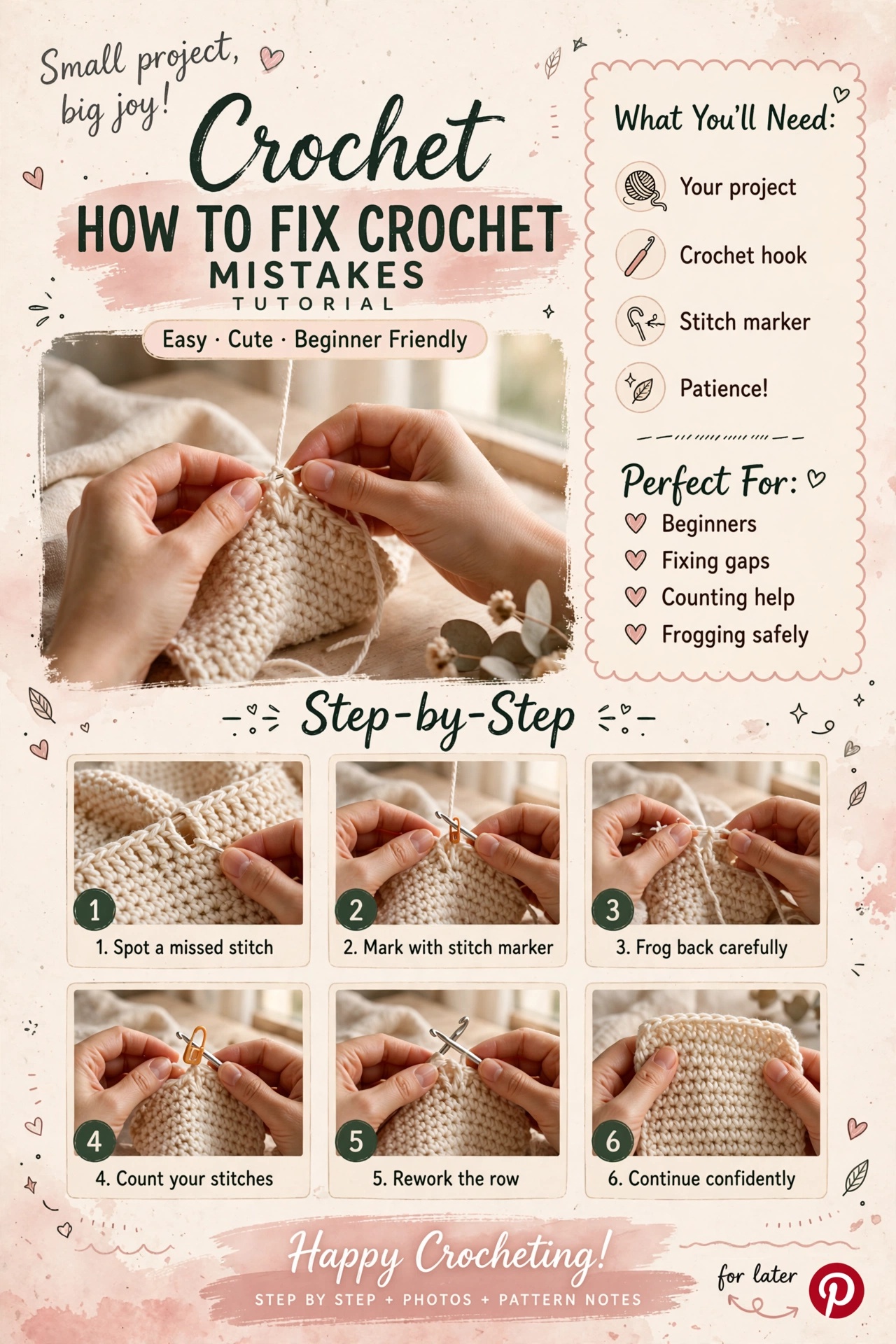
A simple correction routine: count, locate the mistake, undo only as far as needed, then rebuild the row.
Work through the guide in order and use the checkpoints before moving to the next stage.
Materials & preparation
Before you start
Set out your yarn, hook, scissors and needle. Read the complete instructions once before making the first stitch. Write down any target stitch count or finished measurement so you can check your work as you go.
Gauge & tension
Your yarn, hook and personal tension determine the finished fabric. When size matters, make a small swatch and let it rest flat before measuring. Do not force your hands to match a number by gripping the hook harder.
Core pattern / method
Practice swatch
Ch 21 and work 10 rows of sc, aiming for 20 stitches per row.
- Check: Count the row before moving on. If you have 19, you missed a stitch; if you have 21, you added one.
- Missed stitch: Pull back to the gap, insert the hook into the skipped stitch and work one sc.
- Extra stitch: Identify the two stitches worked into one spot and undo the second one.
- Uneven edge: Count the first and last stitch of every row; turning chains do not replace a stitch unless the pattern says so.
- Wrong row: Place a marker in the last correct row, frog back to it, then repeat the instructions.
Rule of thumb
Do not keep crocheting over an error you can already see. A two-minute correction is usually easier than repairing ten rows later.
A four-step mistake check
- Stop at the first sign that the shape or count changed.
- Count the current row and compare it with the pattern.
- Find the last row or round that is definitely correct.
- Mark that point before unraveling so you know where to stop.
Diagnose the mistake before frogging
My row has one stitch too few
Check the first and last stitch, then scan for a skipped V along the row. If the error is in the current row, unravel to that point and work the missing stitch.
My row has one stitch too many
Look for two stitches sharing one insertion point or an accidental stitch in the turning chain. Undo to the extra stitch rather than compensating with a decrease later unless the pattern specifically allows it.
The count is right but the fabric changed
Compare hook size, yarn and tension. A different hook or a tighter grip after a break can change width even when the stitch count stays correct.
I split the yarn
If the hook caught only part of a strand, redo that stitch while it is accessible. Split stitches can look thin and may weaken the fabric.
Rebuild from the last correct point
After frogging, place the working loop back on the hook without twisting it. Recount the last correct row, reread the next instruction, then rebuild slowly. Count again at the end of the repaired row before returning to normal speed.
When not to unravel everything
A tiny cosmetic difference in a non-fitted project may not justify removing many correct rows. Structural errors, wrong stitch counts, misplaced shaping and mistakes that affect fit usually are worth correcting. Decide based on what the error changes, not simply because you noticed it.
For repeated patterns, use stitch markers between repeats. Then a wrong count can often be isolated to one section instead of searching an entire row.
Prevent the same mistake next time
Record the row number before putting a project down, keep the hook with the project, and mark the first stitch of rounds. For complicated repeats, count at the end of each repeat rather than waiting until the full row is finished.
Fix the row where the shape changed
When something looks wrong, I compare the current row with the last row that looked right. Count the stitches in both. If the count changed unexpectedly, look at the first and last stitch first—accidentally skipping an edge stitch or adding one into the turning chain is extremely common.
If the count is correct but the fabric suddenly gets wider, narrower, stiffer, or looser, tension is the next suspect. A different hook, a long break between sessions, or simply gripping the yarn differently can change the fabric without changing the stitch count.
Frogging a few rows is not a failed project. It is usually the fastest route back to a project you actually like.
Final notes
Use this page as a working reference: practice the technique, check the specific checkpoints above, and keep a small sample when it helps you compare future projects.
Repair practice: find the first wrong stitch
Sample yarn: worsted #4 · Hook: 5 mm · Practice target: 16 sc per row.
Abbreviations
sc = single crochet · st = stitch · rep = repeat · frogging = undoing stitches to a previous point.
Numbered repair workflow
- Stop immediately when the shape or stitch count looks wrong.
- Count the current row and write the number down.
- Compare it with the expected count.
- Check the previous row's first and last stitches.
- Look for an increase, decrease or skipped stitch hidden in the middle.
- Undo only to the first incorrect stitch.
- Redo the stitch, then recount the entire row.
Example
If the pattern calls for 16 sc and you count 15, inspect the final stitch first. If you count 17, check for a turning chain or accidental stitch into a space.
Finishing
After repairing, gently flatten the fabric and compare both edges. Do not pull hard to hide a count error; tension cannot reliably correct incorrect construction.