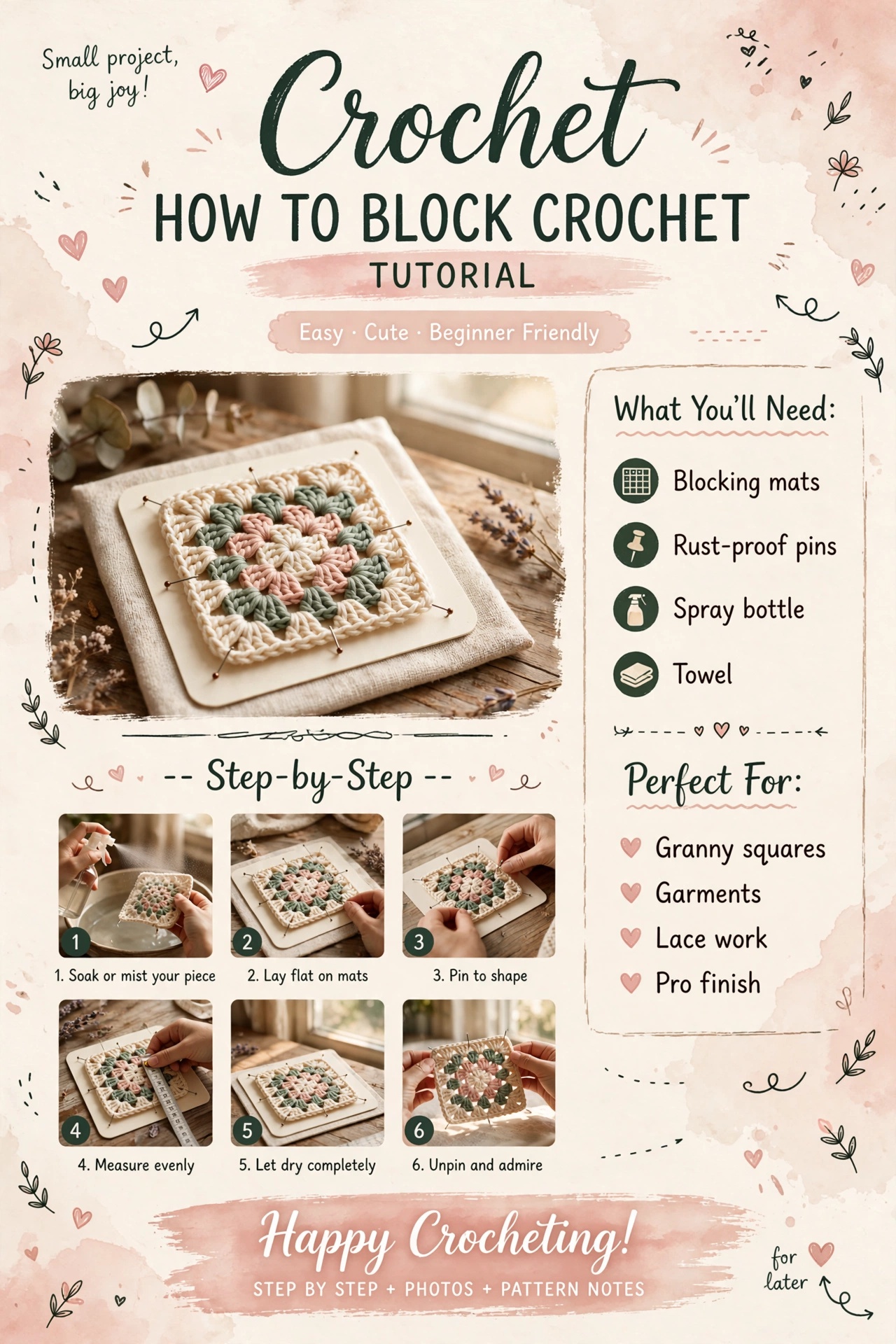
Turn an uneven square into a measured square with gentle wet blocking and careful pinning.
Work through the guide in order and use the checkpoints before moving to the next stage.
Materials & preparation
Before you start
Set out your yarn, hook, scissors and needle. Read the complete instructions once before making the first stitch. Write down any target stitch count or finished measurement so you can check your work as you go.
Gauge & tension
Your yarn, hook and personal tension determine the finished fabric. When size matters, make a small swatch and let it rest flat before measuring. Do not force your hands to match a number by gripping the hook harder.
Core pattern / method
Materials
- Finished crochet square
- Blocking mat or thick towel
- Rust-resistant pins
- Clean water and dry towel
Steps
- Measure: Record the dry size, for example 5 x 5 in / 12.5 x 12.5 cm.
- Wet: Soak until the fibers are evenly saturated; follow the yarn care label.
- Press: Roll inside a towel and press gently. Do not twist.
- Pin: Place the first four pins at the corners and stretch evenly to 5 x 5 in. Add pins every 1–2 in / 2.5–5 cm.
- Dry: Leave completely dry before removing pins.
Important
Heat and moisture can behave differently across fibers. Use only the blocking method recommended for your yarn.
Blocking checkpoints
Measure the piece before adding water so you know what changed. After wetting, support the fabric rather than letting it hang and stretch under its own weight. Pin from the major corners or edges outward, checking the measurement repeatedly instead of pulling one side as far as it will go.
Blocking problems and fixes
The edges look scalloped between pins
Add more rust-resistant pins and distribute tension evenly. Large gaps between pins can create points instead of a straight edge.
The piece stretched too far
Re-wet it if the fiber permits, reshape closer to the natural measurement and let it dry again. Avoid hanging a wet crochet piece because its own weight can lengthen it.
Can I use heat?
Check the yarn label first. Heat affects fibers differently and can permanently damage or flatten some synthetics. When unsure, use the gentlest method appropriate for the fiber.
When blocking is finished
Wait until the piece is completely dry before removing pins. Unpin gradually and remeasure. If motifs will be joined, block them to the same target dimensions before seaming so the corners and stitch spaces line up more predictably.
Wet, spray and steam blocking
Wet blocking saturates the piece and is useful when a fiber responds well to washing and reshaping. Spray blocking adds controlled moisture and works well for smaller adjustments. Steam can reshape some fibers but introduces heat, so keep the heat source off the fabric and follow the yarn manufacturer's care guidance.
Always test an unfamiliar yarn on a swatch before using heat or aggressive stretching on the finished project.
Will blocking survive washing?
Blocking is not necessarily permanent. Washing, wearing and storage can change the shape again, especially with natural fibers. Dry the item in the shape recommended by its care label and re-block when needed.
Match the blocking method to the fiber
Cotton responds well to wet blocking: soak or thoroughly dampen the piece, remove excess water without twisting, shape it to measurements, and let it dry completely. Wool can also respond beautifully to wet blocking, but always follow the yarn's care instructions.
With acrylic, heat needs much more caution because excessive heat can permanently change the fibers. I prefer gentle shaping and avoid pressing a hot iron directly onto crochet. Whatever the fiber, test an unfamiliar method on a swatch first.
Blocking is especially useful before joining motifs. If your granny squares are close in size but not perfectly even, shaping them to the same measurements makes the final seams cleaner.
Final notes
Use this page as a working reference: practice the technique, check the specific checkpoints above, and keep a small sample when it helps you compare future projects.