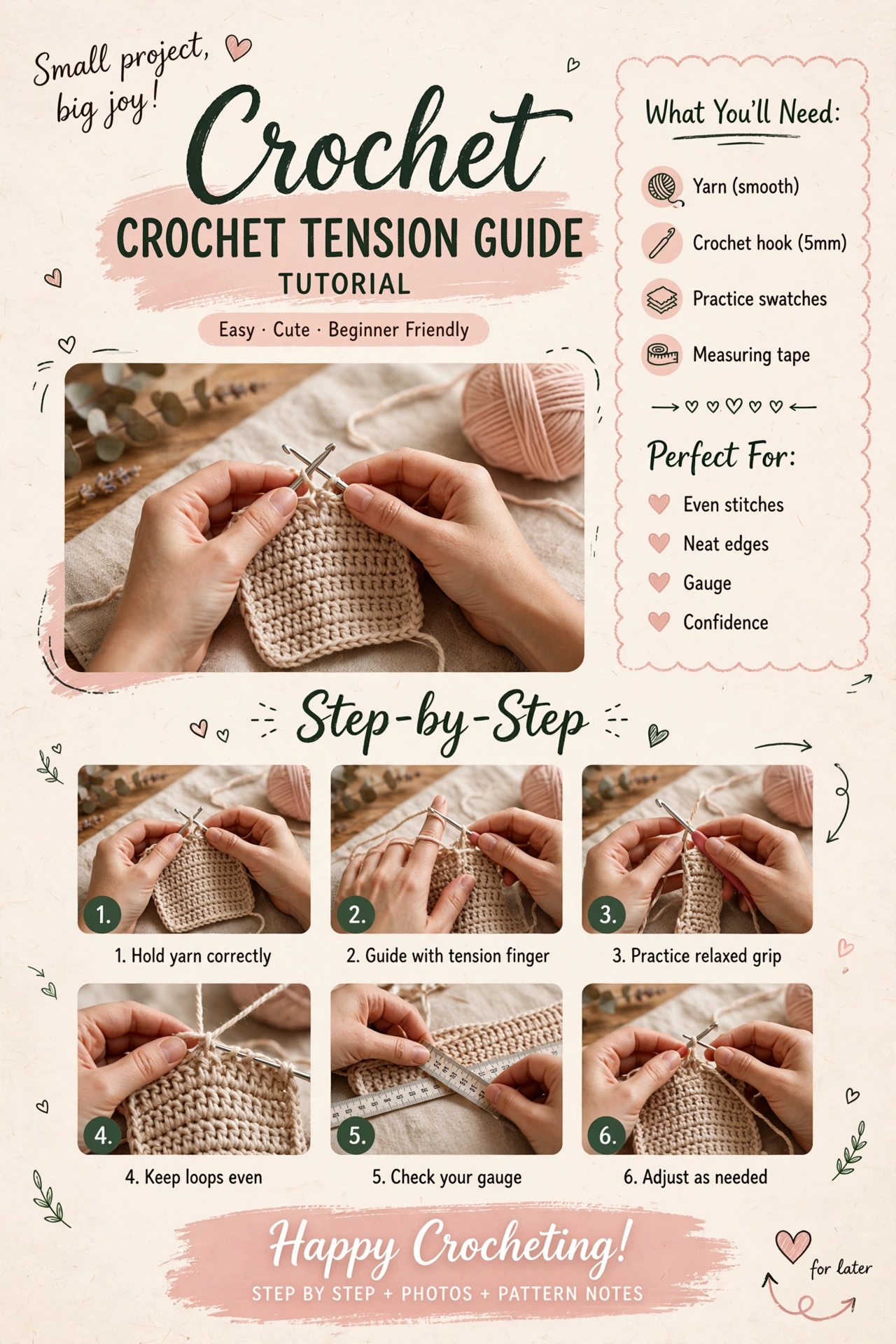
Make a large enough swatch to measure your real working tension instead of relying on the first few rows.
Work through the guide in order and use the checkpoints before moving to the next stage.
Materials & preparation
Before you start
Set out your yarn, hook, scissors and needle. Read the complete instructions once before making the first stitch. Write down any target stitch count or finished measurement so you can check your work as you go.
Gauge & tension
Your yarn, hook and personal tension determine the finished fabric. When size matters, make a small swatch and let it rest flat before measuring. Do not force your hands to match a number by gripping the hook harder.
Core pattern / method
Pattern
- Foundation: Ch 22.
- Rows 1–20: Ch 1, turn, sc across. 21 sc per row.
- Rest: Fasten off and let the swatch lie flat for a few minutes.
- Measure: Place a ruler over the center 4 in / 10 cm. Count stitches and rows without stretching the fabric.
- Adjust: Too many stitches means your tension is tight, so try a larger hook. Too few means try a smaller hook.
Record it
Write down hook size, yarn, stitches per 4 in and rows per 4 in. Keep the note with your pattern so you can reproduce the fabric later.
How to measure gauge accurately
Make the swatch larger than the area you need to measure. Lay it flat without stretching and place the ruler across the center, away from the uneven first and last rows. Count complete stitches across 4 in / 10 cm, then count rows vertically over the same distance.
What your gauge result means
I have too many stitches in 4 inches
Your stitches are smaller than the pattern gauge. Test a larger hook, make a fresh swatch and measure again.
I have too few stitches in 4 inches
Your stitches are larger than the target. Test a smaller hook and compare the new fabric.
Stitch gauge matches but row gauge does not
Check whether the pattern lets you work to a measured length. If row count controls shaping, row gauge matters and may require adjusting loop height or following the designer's sizing guidance rather than changing width gauge blindly.
Wash the swatch when the finished item will be washed
For garments and other size-sensitive projects, treat the swatch the way you plan to treat the finished item, following the yarn care label. Let it dry fully, then measure again. Some fibers relax, bloom or shrink enough to change the useful gauge.
Tension and gauge are related, but not identical
Tension describes how you handle the yarn and form stitches. Gauge is the measurable result: stitches and rows over a given distance. Two crocheters can hold yarn differently yet reach the same gauge with different hook sizes.
Do not strain your hands trying to imitate someone else's grip. Use a comfortable, repeatable motion and adjust the hook to reach the fabric measurement the pattern requires.
Keep a gauge note with the project
Write down the hook, yarn, measured stitch gauge and row gauge. If you stop for several weeks, compare a few rows with the original swatch when you return. That reference can reveal a tension change before it affects a large section.
A useful tension test before a big project
Make a swatch wider than the measurement area, then measure stitches in the center instead of including the edges. If you have too many stitches per 4 inches, your fabric is tighter than the pattern gauge; try a larger hook. Too few stitches means the fabric is looser; try a smaller hook.
Row gauge matters most when the pattern depends on vertical measurements. For scarves and simple blankets, consistency can matter more than matching somebody else's exact gauge. For fitted wearables, both stitch and row gauge deserve attention.
Final notes
Use this page as a working reference: practice the technique, check the specific checkpoints above, and keep a small sample when it helps you compare future projects.