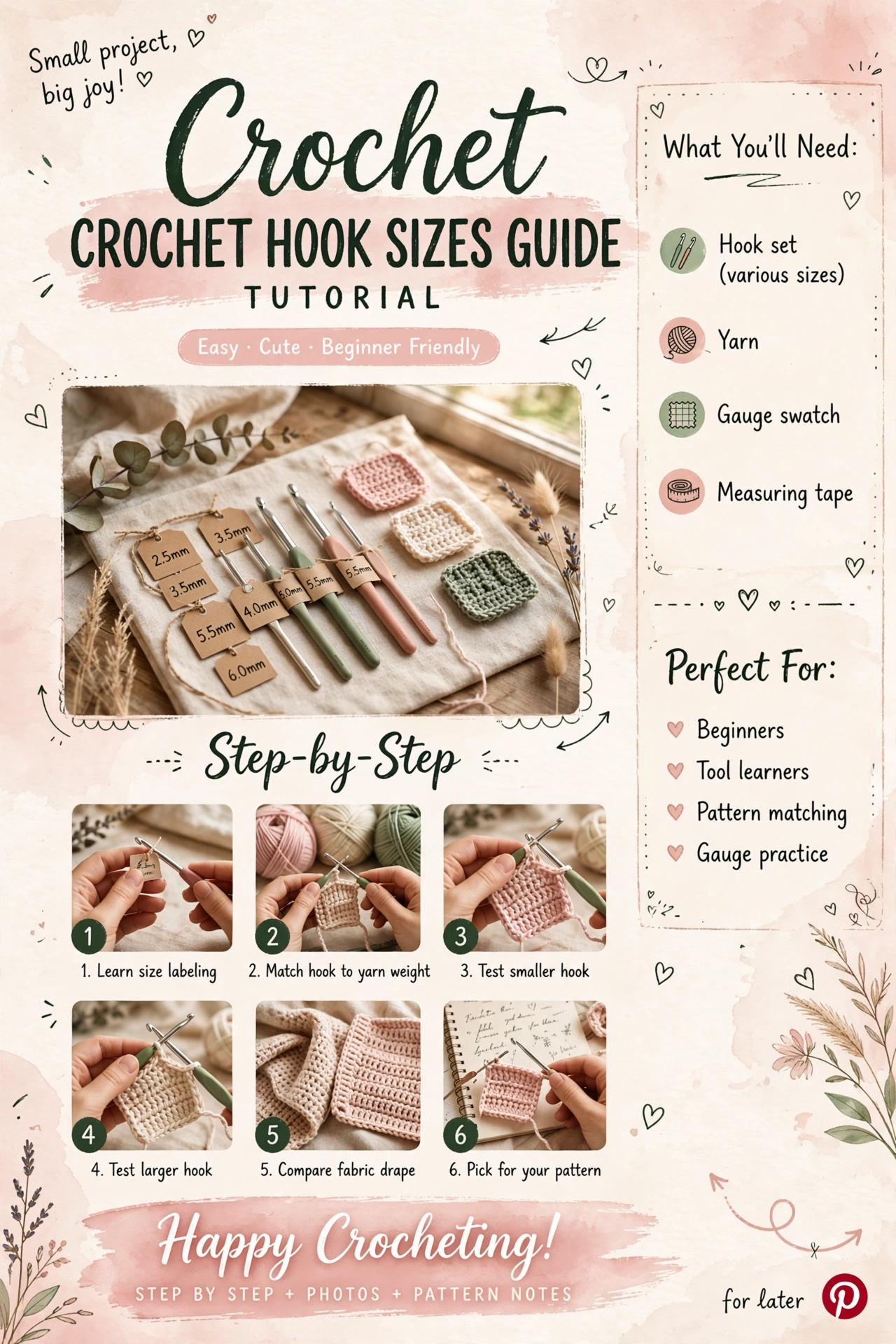
Hey, it’s Sara — a practical hook size chart and how to choose the hook that makes the fabric you want.
Hey, it’s Sara
Hook size is less about “rules” and more about the fabric you want. I’m Sara — here’s the chart I actually use and how I decide when to break it.
US / mm quick chart
- B-1 → 2.25 mm — lace, thread, tiny amigurumi
- E-4 → 3.5 mm — light DK, dense amigurumi
- G-6 → 4.0 mm — DK / light worsted
- H-8 → 5.0 mm — worsted (most patterns on this site)
- I-9 → 5.5 mm — worsted with more drape
- K-10½ → 6.5 mm — bulky
- M/N-13 → 9.0 mm — super bulky / statement pieces
Matching hooks to yarn
Start with the hook printed on the ball band. Then adjust:
- Fabric too stiff / hard to stitch? Go up 0.5–1 mm.
- Fabric too holey / scarves stretch out? Go down a size.
- Amigurumi? Usually 1–2 sizes smaller than the band so stuffing doesn’t show.
How the fabric should feel
For a scarf or blanket, you want soft drape — stitches easy to slide, not cardboard. For a basket or amigurumi, you want structure — firmer fabric, smaller hook.
Choosing the hook from the fabric, not just the label
The hook size printed on a yarn label is a starting point. For amigurumi I usually want a firmer fabric, so a smaller hook can help keep stuffing from showing. For a scarf, shawl, or drapey garment, a slightly larger hook can stop the fabric feeling stiff.
If your hands are fighting the hook and every stitch is hard to enter, going up 0.5 mm can make a bigger difference than forcing tighter yarn through the same fabric. If the fabric looks loose and the project needs structure, try 0.5 mm smaller and compare swatches.
For fitted projects, hook size is only a tool for reaching gauge. Read my tension guide before changing the whole pattern to compensate.
Real examples: same yarn, different hook
Suppose I have a smooth category 4 yarn and three hooks: 4.0, 5.0, and 5.5 mm. For a stuffed toy, I would test the 4.0 mm first because I want compact stitches with no stuffing peeking through. For a basic scarf, I would start around 5.0 mm and check whether the fabric bends easily. If I wanted an airier scarf with more movement, I would compare that swatch with 5.5 mm.
The useful comparison is not “which hook is correct?” It is “which swatch behaves like the finished thing should?” Lay the swatches down, stretch them gently, bend them, and look through them toward a light. That tells you more than the number stamped on the hook.
Quick starting points — then swatch
- Category 2 / sport: roughly 3–4 mm for many everyday fabrics.
- Category 3 / DK: roughly 3.5–4.5 mm.
- Category 4 / worsted: roughly 4.5–5.5 mm.
- Category 5 / bulky: roughly 5.5–8 mm.
- Category 6 / super bulky: often 8 mm and larger.
These are practical starting ranges, not replacements for the yarn label or a pattern's gauge instructions.
When gauge says to change hooks
Imagine a pattern wants 16 stitches across 4 inches. Your swatch has 18 stitches in the same width. Your stitches are smaller, so the finished piece would tend to come out narrower if you followed the pattern unchanged. Try a larger hook and swatch again. If you only have 14 stitches across 4 inches, try a smaller hook.
Measure after making a swatch larger than 4 inches so you can count in the middle, away from distorted edges. For garments, hats, and anything fitted, this small test is worth the yarn it uses. My crochet tension guide goes deeper into fixing gauge without fighting your hands.
Final note from Sara
The “right” hook is the one that makes the fabric you want. Swatch for five minutes and trust your hands.
Three-hook gauge test
Sample yarn: worsted #4 · Starting hook: 5 mm · Test hooks: 4.5, 5 and 5.5 mm.
Gauge target
For a sample project, aim for about 15 sc stitches × 16 rows per 10 cm (4 in). If the pattern specifies a different gauge, use that instead.
Numbered test
- Make three small swatches using the same yarn and stitch.
- Let them relax flat before measuring.
- Count the center 10 cm (4 in), avoiding the edges.
- Compare the fabric with the project's desired density.
- Choose the hook that meets gauge while producing comfortable fabric.
Finished-size example
If a pattern needs 90 stitches at your target gauge, changing hook size can change the final width even when the stitch count stays 90. That is why gauge should be checked before committing to the full project.
Troubleshooting & care
If the fabric is stiff, try a larger hook; if it is too loose, try a smaller one. Recheck after washing when the fiber is likely to change size.