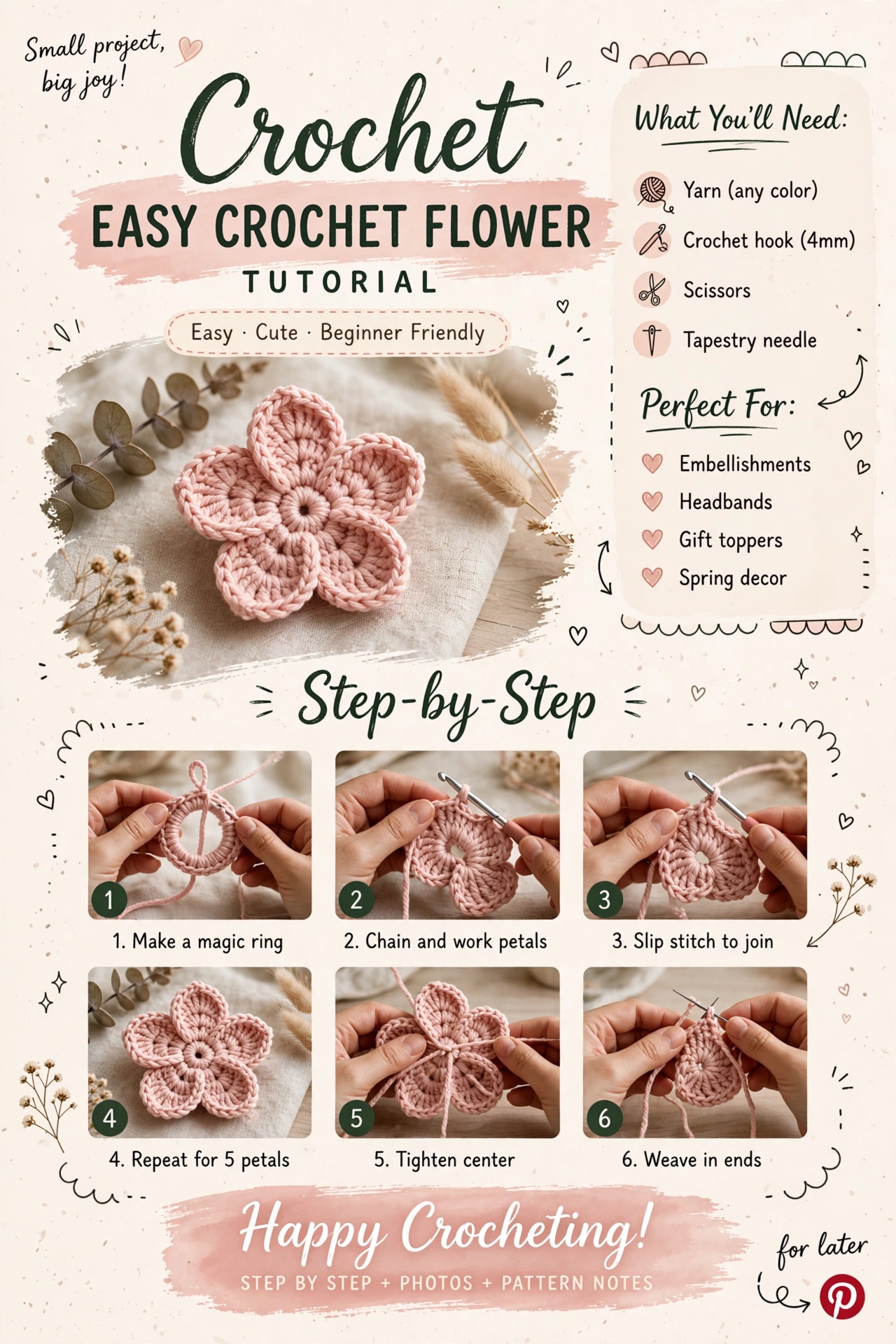
A quick five-petal crochet flower for hats, bags, blankets, cards, gift wrapping, and other small handmade projects.
Work through the guide in order and use the checkpoints before moving to the next stage.
Materials & preparation
Before you start
Set out your yarn, hook, scissors and needle. Read the complete instructions once before making the first stitch. Write down any target stitch count or finished measurement so you can check your work as you go.
Gauge & tension
Your yarn, hook and personal tension determine the finished fabric. When size matters, make a small swatch and let it rest flat before measuring. Do not force your hands to match a number by gripping the hook harder.
Core pattern / method
Materials
- Small amount of worsted or DK yarn in 2 colors
- 4 mm crochet hook
- Scissors and yarn needle
Finished size
About 3 in / 7.5 cm across, depending on yarn and tension.
Abbreviations
MR = magic ring · ch = chain · sc = single crochet · dc = double crochet · sl st = slip stitch
Pattern
- Round 1: Make a magic ring, ch 1, then work 10 sc into the center. Sl st to the first sc. 10 sc.
- Round 2: For each petal, work ch 3, 2 dc, ch 3, then sl st into the next stitch. Repeat until 5 petals are formed.
- Round 3: Join the second color behind the petals. Use the center stitches to create a neat base for the next layer if you want a two-color flower.
- Round 4: In each available loop work [sc, 3 dc, sc]. Repeat around for fuller outer petals.
- Finish: Sl st to the starting point, fasten off, and weave the ends securely.
Stitch-count checkpoint
You should have five visually similar petals. If you get four or six, check the skipped stitch between petals and make sure the center round has 10 sc.
Make it your own
Use a 3 mm hook for a smaller flower or a 5 mm hook and thicker yarn for a larger applique. Try the flower as a bag charm, zipper pull, hair accessory, blanket motif, or gift decoration.
More beginner crochet projects
Practice the classic granny square next, or learn the magic ring if adjustable centers are new to you.
Five-petal flower checkpoints
Count the 10 single crochets in the center before starting petals. Each petal uses the same sequence, so compare every new petal with the previous one before moving on. After five repeats, the petals should be distributed evenly around the center without a large unused gap.
Flower troubleshooting
The center will not close
Make sure all 10 center stitches were worked around the adjustable loop and its tail. Hold the stitches with one hand and pull the tail steadily. If your yarn grips itself, close the ring in small pulls rather than yanking.
Petals are different sizes
Check that every petal has the same chain and double-crochet sequence. Uneven loop height also changes petal size, so let the hook control the loop instead of tightening each stitch after it is made.
The flower curls
A little cupping can relax after finishing, but strong curling usually means the center is too tight for the petal layer. Try a slightly larger hook or relax the center-round tension.
Finishing an appliqué neatly
Fasten off on the back and weave each tail through several nearby stitches without pulling the center out of shape. If the flower will be sewn to a hat, bag or blanket, leave one long tail for attaching it. Pin the flower in position first, then sew around the center and selected petal bases so the edges stay dimensional.
Useful flower variations
For a smaller appliqué, use lighter yarn and a smaller hook while keeping the stitch sequence unchanged. For a fuller flower, add a second petal layer behind the first rather than simply making the original petals tighter. Two colors make the center and petals easier to distinguish; one color gives a simpler motif.
Make one test flower before producing a garland or set so you can record the yarn, hook and finished diameter.
Using and caring for crochet flowers
Match the care method to both the flower yarn and the item it is attached to. For washable bags or blankets, secure the attachment tail in more than one direction. For cards, gift wrap or removable decorations, avoid permanent attachment so the flower can be reused.
Changing the flower without rewriting the pattern
The easiest way to change the look is yarn weight. A finer yarn and smaller hook make a delicate appliqué; worsted yarn makes a bolder flower for bags or garlands. Keep the stitch sequence the same and make one test flower before producing a whole set.
For an appliqué, leave a long finishing tail so the flower can be sewn down securely. For a garland, weave the ends first and attach the flowers afterward so the back stays tidy.
Final notes
Use this page as a working reference: practice the technique, check the specific checkpoints above, and keep a small sample when it helps you compare future projects.
Five-petal crochet flower pattern
Sample yarn: cotton #3–4 · Hook: 4 mm · Finished size: about 6–8 cm (2.5–3 in).
Abbreviations
ch = chain · sl st = slip stitch · sc = single crochet · dc = double crochet · rep = repeat.
Numbered instructions
- Make a magic ring or ch 4 and join with a sl st.
- Ch 1, then work 10 sc into the center. Join to the first sc.
- For each petal, skip 1 stitch, then work 1 sc, 3 dc, 1 sc in the next stitch. Repeat until five petals are formed.
- Join with a sl st, fasten off and weave the ends securely.
Stitch-count checkpoint
You should have five visually similar petals. If you get four or six, check the skipped stitch between petals and make sure the center round has the expected 10 sc.
Variations
Use 4 dc for fuller petals or a smaller hook for a firmer applique. Make one test flower before producing a matching set.
Care
Shape petals while damp only if the yarn care label permits washing; otherwise gently arrange the flower by hand.