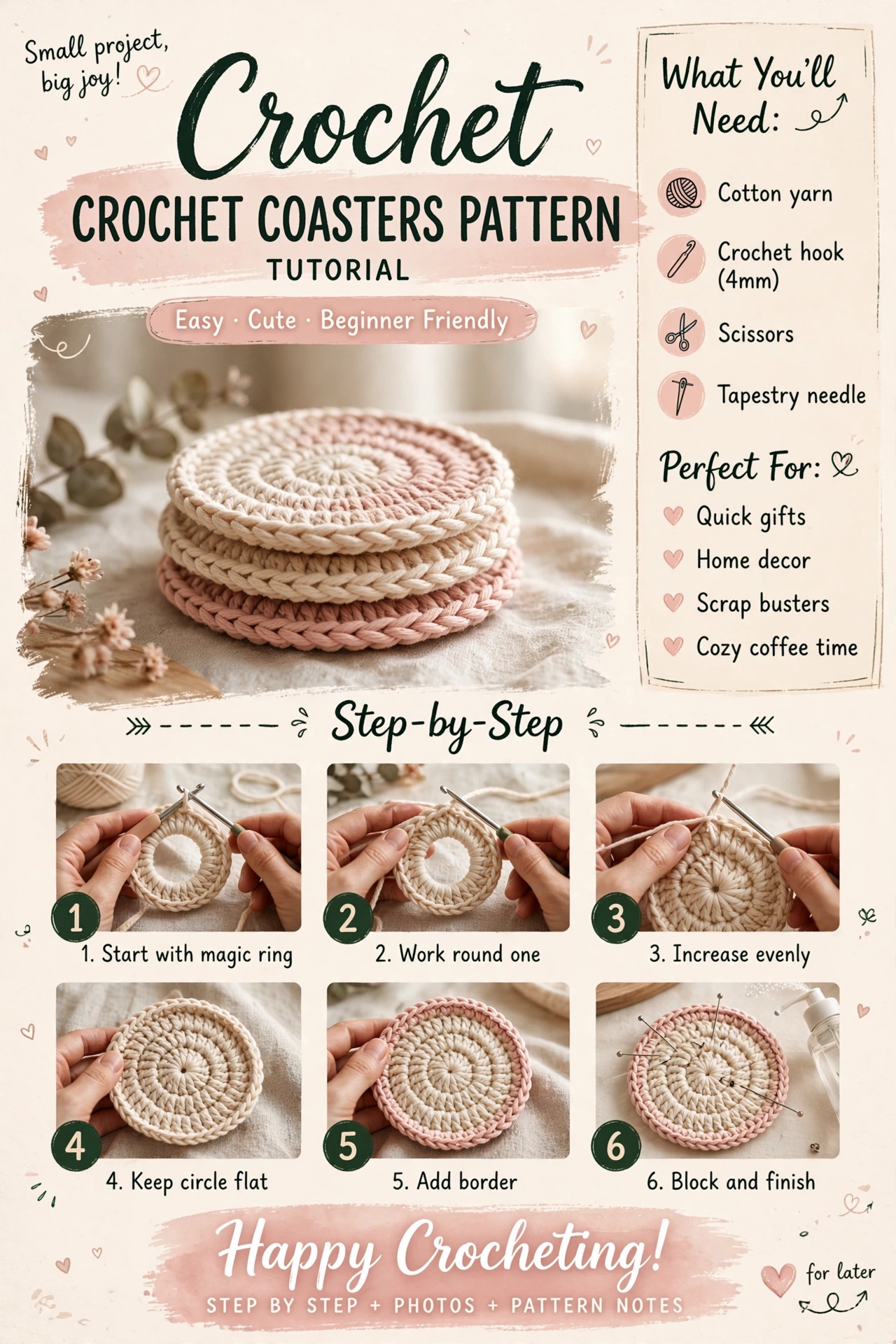
A sturdy round coaster designed to lie flat and finish in a few short rounds.
Work through the guide in order and use the checkpoints before moving to the next stage.
Materials & preparation
Before you start
Set out your yarn, hook, scissors and needle. Read the complete instructions once before making the first stitch. Write down any target stitch count or finished measurement so you can check your work as you go.
Gauge & tension
Your yarn, hook and personal tension determine the finished fabric. When size matters, make a small swatch and let it rest flat before measuring. Do not force your hands to match a number by gripping the hook harder.
Core pattern / method
Materials
- Cotton yarn, about 25 yd / 23 m
- 4 mm hook
Pattern
- Round 1: MR, 8 sc. 8 st.
- Round 2: Inc around. 16 st.
- Round 3: [Sc 1, inc] around. 24 st.
- Round 4: [Sc 2, inc] around. 32 st.
- Round 5: Sc around. 32 st.
- Round 6: [Sc 3, inc] around. 40 st.
- Finish: Sl st, fasten off and weave ends.
Make a set
Repeat the pattern four times using two colors. Block the coasters flat and let them dry completely before use.
Project-specific checkpoints
Use the stitch counts, measurements and shape described in the core method above as your checkpoints. Stop at each repeat or construction change and compare the fabric with the intended result before continuing.
Troubleshooting
The finished shape looks different
Check stitch count, yarn weight, hook size and tension in that order. A small difference in any one of these can change the finished fabric. Correct construction first; use blocking only for final shaping.
My stitches feel inconsistent
Slow down for one row, relax your shoulders and keep the hook movement small. Consistency improves when the hand motion becomes repeatable, not when you pull the yarn tighter.
I made a mistake several rows back
Find the first wrong stitch, unravel only to that point and rebuild the section. Carrying an incorrect stitch forward usually makes the final repair harder.
Finish for the way this project will be used
Secure every working tail through compatible stitches without distorting the fabric. Check the edges, joins and any load-bearing area before trimming tails. Shape or block only when the yarn's care instructions and the construction make that appropriate.
Variations & next projects
Once the base version feels comfortable, change one variable at a time: color, yarn weight, hook size, border or finished dimensions. Keeping the rest of the method unchanged makes it easier to understand what each change does.
Repeat the same construction in a new color palette or size before moving to a completely different technique. This is one of the fastest ways to turn a tutorial into a skill you can reuse.
Care based on fiber and construction
Keep the yarn label and follow its washing and drying directions. Before washing a finished piece, also consider its construction: handles, seams, stuffing, embellishments and mixed fibers may require gentler care than the yarn alone.
What makes a crochet coaster work
A coaster needs to sit flat before it needs to look decorative. Cotton is my first choice because it handles moisture well and gives clear stitches. I avoid very fuzzy yarn because it hides the shape and makes the surface less stable under a glass.
After finishing, place the coaster on a table and look at it from the side. If the edge lifts, blocking can help a small tension issue; a strong ruffle or bowl shape usually means the increase math needs correcting instead.
Final notes
Keep the first successful sample and note the yarn, hook, measurements and any adjustment you made. That record is more useful than trying to remember the setup later.